
A lot of homemade gravy misses in a very specific way: it looks perfect, coats the spoon, and still tastes oddly muted. That usually means the problem is not texture. It is flavor structure. The gravy thickened, but the base did not build enough depth, seasoning, contrast, or finish to feel complete. Because gravy is often made from ingredients that already carry value, like pan drippings, butter, stock, and roasting time, starting over is usually the wrong first move. A better one is a quick diagnosis, then one precise correction at a time. Quality stock, flavorful drippings, and a properly cooked roux do a surprising amount of the work before extra seasoning ever enters the pan. (extension.psu.edu)

- If the stock or drippings taste weak before thickening, the finished gravy will usually taste weak too. (extension.psu.edu)
- Flat gravy is usually missing one or more of four things: a strong foundation, proper seasoning, brightness, or a toasted, well-cooked thickener. (ciafoodies.com)
- The fastest rescue sequence is: taste, reduce if needed, season in small steps, add a tiny savory booster, then finish with a little acid.
- A thick gravy can still taste bland because thickness is body, not flavor.
- For leftovers, cool meat-based gravy promptly and reheat it to 165 degrees F; USDA also says gravies and sauces should be brought to a rolling boil when reheated. (fsis.usda.gov)
What flat gravy usually means
When cooks say gravy tastes flat, they usually do not mean one single thing. They mean the gravy has no lift. It may be thick but watery, salty but boring, rich but muddy, or smooth with a faint raw-flour edge. In practical terms, flat gravy often comes from weak stock, too few drippings, a roux that was not cooked long enough to develop a nutty flavor, or a batch that never got a final balancing step such as pepper, Worcestershire, or a small splash of acid. Even a make-ahead gravy built on good stock typically needs tasting and adjustment at the end because the finished sauce depends heavily on the richness of the stock and the final seasoning. (extension.psu.edu)
Use the FLAT Gravy Audit before you add anything else
Diagnosing bland gravy correctly is essential for fixing it quickly. This simple scorecard (0-2) can help assess the gravy by scoring it a 0 if it does not have any flavor, a 1 if it has some flavor, and a 2 if it is full of flavor. Any category that receives a 0 must be addressed before adding salt; otherwise, you may dilute the stock and lose brightness as a result.
- F = Foundation. Taste the gravy base. Does it actually taste like chicken, turkey, beef, or mushrooms before you focus on texture? If the stock is thin or the drippings are minimal, the gravy has no real core. Homemade stock and browned pan drippings materially strengthen the finished sauce. (extension.psu.edu)
- L = Leveling. Is the seasoning high enough for the amount of liquid in the pan? Low-sodium stock is useful, but many gravies stay timid because the cook never finishes the salt. A tiny amount of Worcestershire, soy sauce, or MSG can also deepen savoriness without making the gravy taste like those ingredients when used carefully. FDA describes MSG as a flavor enhancer and notes that glutamate is naturally present in foods such as tomatoes and cheeses. (fda.gov)
- A = Acid and aroma. A rich sauce often needs a small finishing note to wake it up. A little lemon juice or cider vinegar can brighten flavor at the end, while black pepper and fresh herbs restore aroma that long simmering can flatten. (epicurious.com)
- T = Toast and texture. Roux is not just a thickener. Its color and cook time affect flavor. A pale roux can work, but if the flour cooked only briefly, the gravy may feel pasty or unfinished. Culinary Institute guidance on roux and white sauces emphasizes that cooking the roux develops nuttiness and helps remove raw flour flavor. (ciafoodies.com)
Another useful rule is: Don’t make two major adjustments at the same time. If you add a large amount of salt to your sauce and add an acid at the same time, it will be hard to know if one of the adjustments helped fix the sauce or caused it to be unbalanced.

A realistic 4-cup example
Imagine a weeknight chicken gravy made with four cups of low-sodium boxed stock, four tablespoons of butter, four tablespoons of flour, and roughly two tablespoons of pan drippings from a sheet-pan roast. It thickens nicely and has a glossy finish, but the first bite will taste very bland. When running the FLAT audit, you get a foundation score of zero because you are using a mild stock and few pan drippings, so you wouldn’t use a full score for this gravy. When it comes to the seasoning, you will get a leveling score of one because the batch is not seasoned fully. The acid and aroma will be scored zero since there will be nothing in this gravy to buy it a joie de vivre when finishing with lemon juice or cider vinegar. The toast and texture will get a score of one due to the roux only being cooked for roughly one minute. There is not enough flour or butter to rescue your gravy. The best rescue option is to simmer the gravy down slightly until the taste of the flour mellows out before adding seasoning (salt/pepper) in small increments. For a four-cup batch, you may need to reduce by 1/2 cup to start with, and then add kosher salt in 1/4 teaspoon increments. Next, add 1/2 to 1 teaspoon of Worcestershire sauce per 4-cup batch and finish with either 1 teaspoon of lemon juice or 1/2 teaspoon of apple cider vinegar off the heat. The end result will be the same gravy but with a much clearer flavor.
Which fix matches the taste in the spoon?
| If the gravy tastes like this | Most likely cause | Best first fix | What not to do |
|---|---|---|---|
| Thick but watery | Weak stock or too little reduction | Simmer 3 to 5 minutes to concentrate, or add better drippings or stock | Do not add more flour first |
| Salty but still boring | Not enough savoriness or aroma | Add pepper, a little Worcestershire or soy, or a pinch of MSG if you use it | Do not keep salting |
| Rich but dull | Needs contrast | Add 1/2 teaspoon acid at a time off heat | Do not pour in a big splash all at once |
| Smooth but floury | Roux undercooked | Simmer longer and whisk often | Do not mask it with extra herbs |
| Greasy and heavy | Too much fat or too much finished richness | Skim excess fat, thin slightly with hot stock, then adjust salt and pepper | Do not add more butter |
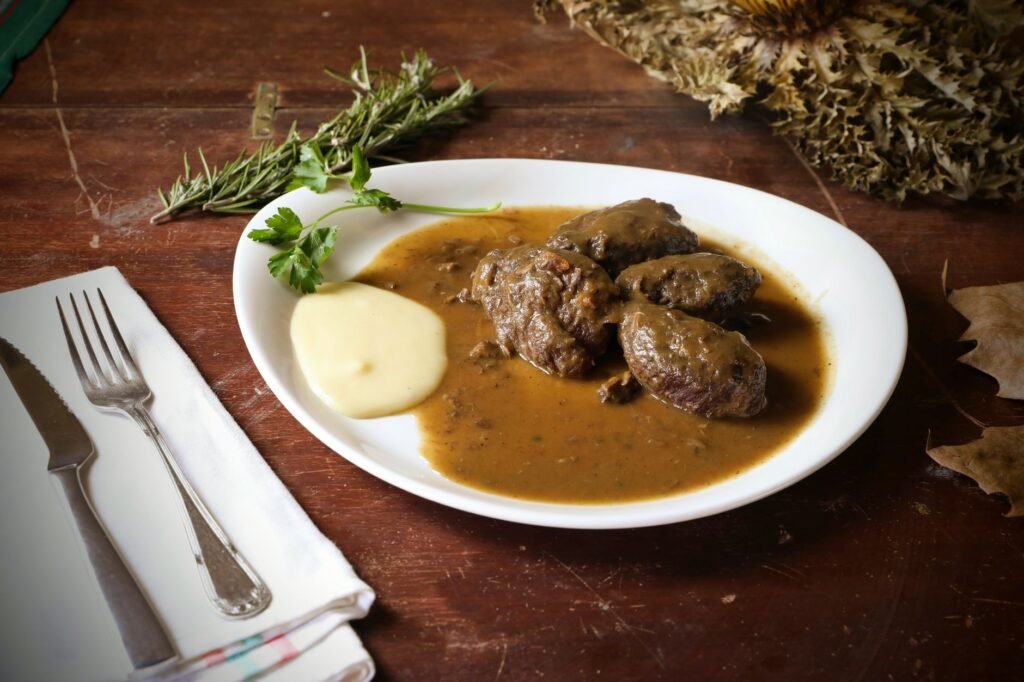
The 10-minute gravy reset
- Taste a spoonful slightly cooled, not blazing hot. Very hot gravy can hide both salt and acid.
- Ask the FLAT questions in order: foundation, leveling, acid and aroma, toast and texture.
- If the base tastes weak, simmer the gravy uncovered for a few minutes. Reduction is often the cheapest fix because it uses the flavor already in the pot.
- If the base is good but underseasoned, add kosher salt in small increments. For a 4-cup batch, 1/4 teaspoon at a time is a sensible pace.
- If it still tastes bland after proper salt, add a tiny savory booster. Start with 1/2 teaspoon Worcestershire or soy sauce, or a pinch of MSG if that fits your cooking style. FDA classifies MSG as a flavor enhancer, which is why it can help a gravy taste fuller without adding a separate dominant flavor. (fda.gov)
- If the gravy feels heavy or sleepy on the finish, stir in acid off heat. Start with 1/2 teaspoon lemon juice or cider vinegar, taste, and stop as soon as the gravy tastes more alive rather than tart. Small finishing acid is a classic way to brighten sauce without making it taste overtly citrusy. (epicurious.com)
- If the gravy has a raw-flour edge, keep it at a gentle simmer and whisk. Roux-based sauces need enough time for the starch and flour flavor to settle into the liquid. (ciafoodies.com)
- Retaste on food, not just from the spoon. A gravy that tastes slightly intense on its own often lands correctly over mashed potatoes, rice, meat, or biscuits.
Common mistakes that make gravy boring
- Using a stock you would not enjoy drinking on its own. If the stock is weak, the gravy starts behind. (extension.psu.edu)
- Relying on thickness as proof of flavor. A correctly thick gravy can still be bland.
- Skipping the browned bits in the roasting pan. Those drippings often provide the roast notes people expect from gravy. (kingarthurbaking.com)
- Cooking the roux just until combined, then adding liquid too soon. That can leave the sauce tasting chalky or flat. (ciafoodies.com)
- Trying to hide a weak base with a lot of dried sage, garlic powder, or onion powder. That changes the profile, but it does not create depth.
- Adding acid too early or too heavily. The point is brightness, not obvious tang.
- Fixing three things at once. Good gravy troubleshooting is incremental, not dramatic.
When your first fix still is not enough
Sometimes the usual fix list is not enough because the underlying batch has a structural problem. If the gravy is already salty, reduction may make it worse. In that case, thin it first with unsalted stock or hot water, then bring back interest with pepper, a little acid, and a small savory booster instead of more salt. If the gravy is greasy, skim fat before you judge the flavor; too much surface fat can dull the palate. If the gravy was thickened with cornstarch rather than roux, keep in mind that thickening alone will not add flavor, so you may need a separate flavor concentrate: simmer a little stock with drippings, a spoonful of browned shallot, or a dab of tomato paste, then whisk that concentrate into the main pan. If you are making vegetarian gravy, mushrooms, soy sauce, miso, or a small pinch of MSG can help replace the savoriness that meat drippings normally provide. MSG is optional, but FDA notes that it functions as a flavor enhancer and that glutamate is also naturally present in many foods. (fda.gov)
How to pressure-test the gravy before serving
- Put 1 tablespoon of gravy on something plain, like mashed potatoes, roast chicken, rice, or a torn piece of bread.
- Wait 15 to 20 seconds. A slightly cooled bite is much easier to judge accurately.
- Ask three questions: Do I taste the roast base? Does the seasoning show up clearly? Does the finish feel lively rather than heavy?
- If one answer is no, make one change only, then retest. That keeps the fix precise.
- If guests are about to sit down, stop when the gravy tastes clearly savory and balanced. Chasing perfection in the last two minutes is how gravies get over-salted.
If your gravy contains meat or poultry drippings, refrigerate leftovers promptly in shallow containers. USDA guidance says leftovers should be reheated to 165 degrees F, and sauces, soups, and gravies should be brought to a rolling boil when reheated. (fsis.usda.gov)
Bottom line
The majority of flat gravies are not broken, as they have never been finished. Oftentimes, you can improve the pot by adjusting the foundation (FLAT); adding more seasoning or flavourings to enhance aroma (acid and/or black pepper); and verify the roux has actually been cooked. It’s the steps above that transform gravies from simply thick to complete.

FAQ
Why does my gravy taste bland even though I used the right measurements?
Because correct measurements can still produce a weak flavor base. Gravy depends heavily on the quality of the stock, the amount of pan drippings, and how fully the roux and seasonings develop. Recipes can give you texture, but flavor still needs tasting and adjustment. (extension.psu.edu)
Can I fix flat gravy without adding more salt?
If enough seasoning is already in the gravy, it may be reasonable to reduce it some more, add a small amount of Worcestershire or soy sauce as a savory booster, add a little black pepper, or a touch of finishing acid to help improve the flavor. Salt is one flavor component but not the sole answer.
Does lemon juice really belong in gravy?
A very small amount can. Used carefully at the end, acid brightens rich sauces and helps them taste more finished. The goal is not to make the gravy taste lemony. It is to make the existing savory flavor stand out more clearly. (epicurious.com)
Is MSG safe to use in gravy?
FDA says MSG is generally recognized as safe and describes it as a flavor enhancer. If you already cook with it and enjoy it, a small pinch can help bland gravy taste fuller. It is optional, not required. (fda.gov)
Why does my gravy taste floury?
That usually points to the roux. If the flour and fat were not cooked long enough before the liquid went in, the finished gravy can keep a raw or pasty note. A few more minutes of proper cooking and simmering often improve it. (ciafoodies.com)
What is the fastest emergency fix right before dinner?
Sample that flavor profile and add salt, but only if it is too bland; after that, a tiny dash of savory, and a tiny dash of brightness are both good ways to go. For example, with a 4-cup recipe, try adding Worcestershire sauce and then a small amount of lemon juice or cider vinegar at a time, tasting after each adjustment.
References
- Penn State Extension: Preparing and Preserving Your Own Chicken or Turkey Stock – https://extension.psu.edu/preparing-and-preserving-your-own-chicken-or-turkey-stock
- CIA Foodies: All About Roux – https://www.ciafoodies.com/all-about-roux/
- CIA Foodies: Culinary School: How to Make Béchamel Sauce – https://www.ciafoodies.com/culinary-school-how-to-make-bechamel-sauce/
- King Arthur Baking: Make-Ahead Gravy Recipe – https://www.kingarthurbaking.com/recipes/make-ahead-gravy-recipe
- FDA: Questions and Answers on Monosodium glutamate (MSG) – https://www.fda.gov/food/food-additives-petitions/questions-and-answers-monosodium-glutamate-msg
- FDA: Types of Food Ingredients – https://www.fda.gov/food/food-additives-and-gras-ingredients-information-consumers/types-food-ingredients
- USDA FSIS: Leftovers and Food Safety – https://www.fsis.usda.gov/food-safety/safe-food-handling-and-preparation/food-safety-basics/leftovers-and-food-safety
- Ask FSIS: What methods of reheating food are safe? – https://ask.fsis.usda.gov/article/What-methods-of-reheating-food-are-safe
- Epicurious: To Finish a Dish, Turn to the Humble Lemon – https://www.epicurious.com/ingredients/how-to-use-lemon-juice-to-finish-a-dish-recipes-article
- Penn State Extension: Ways with Applesauce – https://extension.psu.edu/ways-with-applesauce/