
- Most watery soup starts with dilution: extra water, weak broth, or too much liquid added before the flavor base is strong enough to carry it. Penn State Extension notes that soup can be concentrated simply by using less water or other liquid. (extension.psu.edu)
- Stock usually brings more body than broth because it is commonly made from bones and simmered longer, while broth is generally lighter. If you stretch broth with more water, thin soup becomes much more likely. (cfaes.osu.edu)
- Use the BOWL test before serving: Base, Occupancy, Weight, Last-minute lift.
- If the pot is bland and thin, reduce it uncovered. If it is already salty, do not reduce; add unsalted body instead, then adjust seasoning at the end.
- If you are batch-cooking, cool soup quickly in shallow containers. USDA warns that a big pot of soup cools slowly, and leftovers generally should be refrigerated promptly and used or frozen within 3 to 4 days. (fsis.usda.gov)
Many home cooks believe that the last step in making the soup is where the fault lies in watery soup. They often try adding more salt, pepper, or some hot sauce to “wake up” the bowl of soup at this point. However, the mistake was likely made long before this. The main mistake in this scenario is adding too much volume before adding any flavour to your soup. You will find that by adding a lot of ingredients quickly, you fail to let some of the ingredients such as onions, garlic, herbs, fat, and chicken to develop their flavour or concentrate in order to season all that liquid that has been added to the pot. Therefore, although the soup may appear to be a lot of soup, it does not actually taste like it.
In addition to flavor, soup is one of the simplest forms of cooking at home from cheap materials. With a few vegetables, inexpensive protein and pantry staples (such as beans, peas or rice), you can create several servings of soup for under $5, easily stretching your grocery budget throughout the week. Conversely, watery soup is also an easy way to waste food. Most people do not eat leftover soup that appears to be mostly just flavored water, regardless of how good the recipes were originally.
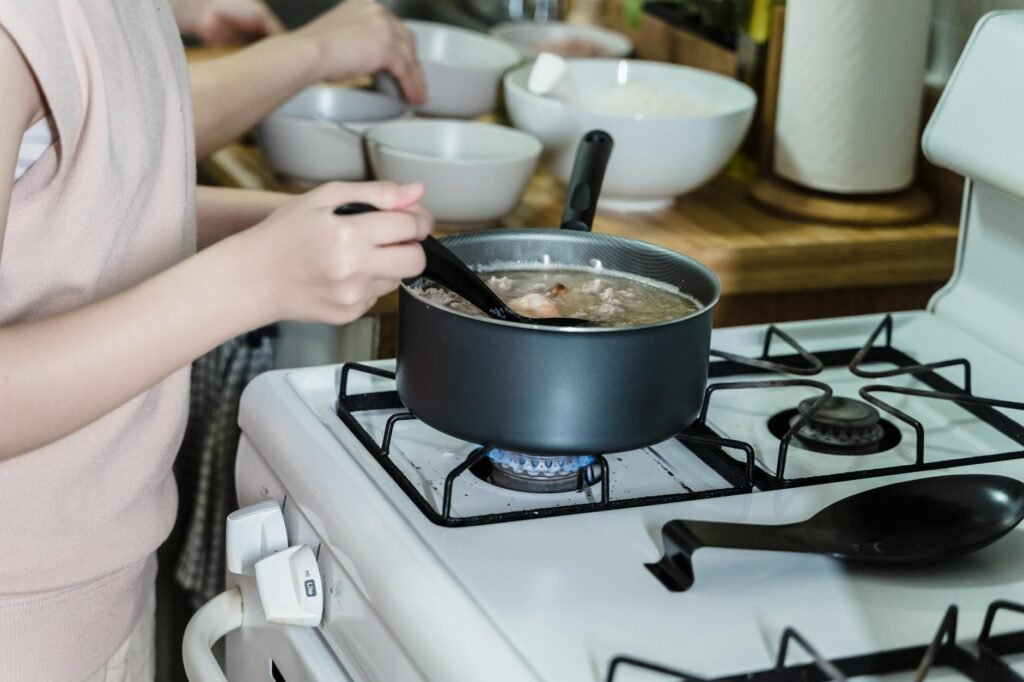
The real mistake is dilution, not just weak seasoning
If you remember one rule, make it this: the base has to earn the liquid. A good soup base should already taste promising before the full amount of broth or water goes in. That is why watery soup shows up so often in rushed weeknight cooking. The vegetables are barely softened, the meat has not browned much, the tomato paste is still raw, and then four or five extra cups of liquid go into the pot. Penn State Extension puts the fix plainly: soup can be concentrated by using less water or other liquid. (extension.psu.edu)
Your choice of liquid matters too. Ohio State University Extension explains that stock is typically made with bones and aromatics and is thicker because collagen and marrow are extracted during cooking, while broth is generally lighter and cooks for less time. That does not mean broth is a bad ingredient. It means broth gives you less margin for error if you also add water, under-brown the aromatics, or expect the solids to carry the whole pot. (cfaes.osu.edu)
One more trap is the label on the carton. FDA says low sodium means 140 mg of sodium or less per serving, while reduced sodium means only 25% less than the regular version. Two boxes that look similarly healthy on the shelf can behave very differently in the pot. If you plan to simmer soup down for more flavor, that distinction matters because salt concentrates as liquid cooks off. (fda.gov)
Use the BOWL test before you ladle
- B = Base. Taste the liquid by itself. If it tastes like hot water with a memory of vegetables, stop and fix the pot before serving.
- O = Occupancy. Look at one full ladle. A hearty soup usually wants a visible balance of solids and liquid, not a few lonely pieces at the bottom.
- W = Weight. Swirl a spoonful. Does the broth feel slightly rounded, or does it run off the spoon like tinted water? If it feels weightless, it needs reduction or body.
- L = Last-minute lift. Even a well-built soup can need a finishing lift from acid, herbs, black pepper, or a small amount of fat right before serving.
Before a supper basin contains liquid, the quickest method for catching the batch before reaching the table is by doing a BOWL measurement. If the soup does not pass two of the BOWL tests, it will likely be in a wrong stage of readiness; therefore, 10-15 minutes will usually be required to correct the problem while it is still in the pot. However, once everyone feels the leftovers are no longer exciting, it will be even more difficult to fix.
A realistic weeknight example with numbers
Say you are making a chicken and white bean soup for a household of four with leftovers for lunch. The pot includes 1 pound of chicken thighs for $5.49, one onion for $0.89, carrots and celery for $2.10, two cans of white beans for $2.20, one carton of broth for $2.79, and pantry seasonings and oil for roughly $1.00. Total cost: about $14.47. The common mistake is stretching that pot with an extra 3 to 4 cups of water so it looks like more food. On paper, you might get 10 cups instead of 8. In practice, you often get 10 thin cups that nobody wants to finish. A better move is to keep the liquid tighter, mash or blend part of the beans for body, and serve 8 bowls that taste complete. The sticker price per serving looks a little higher, but the cost per eaten serving is lower because the leftovers actually get eaten.
| What you taste | Most likely cause | Best fix now | What to avoid |
|---|---|---|---|
| Bland and thin | Too much liquid or a weak base | Simmer uncovered for 10 to 20 minutes; add a more concentrated stock or a small amount of cooked tomato paste | Adding salt first |
| Salty but still thin | Store-bought broth gave you salt, not depth | Add unsalted body such as blended beans, potatoes, rice, or more cooked vegetables | Reducing further |
| Broth tastes okay but the bowl feels flat | Missing fat, acid, or aroma | Finish with olive oil, butter, lemon, vinegar, herbs, or black pepper | Boiling hard after finishing |
| Cream soup is thin | Not enough starch or puree, or too much dairy dilution | Blend part of the soup or add potato, bean, or squash puree | Trying to solve it with more milk |
| Hearty ingredients, weak broth | Good solids in too much liquid | Remove some solids, reduce the broth, then return everything to the pot | Serving it just because the solids look substantial |
How to fix watery soup without starting over
- You should first sample only the broth. Choose a very small amount of shell, or solids. With respect to strength, if your broth is weak and unflavourful, then your foundation may be a problem; if it is salty but flavourless, then you need to work on developing character.
- Choose one main correction path. Do not throw five fixes at the pot at once. Watery soup usually needs one of three things: concentration, body, or a finishing lift.
- To strengthen the soup add additional time to cook down the liquid that surrounds all the ingredients in the pot or pan. A slow boil for fifteen minutes will create much more concentrated flavors, than simply using one more teaspoon of salt.
- When using unseasoned liquid to make your soup instead of boiling down due to excess sodium. To do this you will boil a cup or two of a bean/potato/rice/lentil/cooking vegetable in some broth and puree it before blending the puree with your soup. This will help thicken and distribute the salt over a larger area of food.
- If your soup has a bland flavour, enhance the aroma by cooking some onion/garlic in a separate pan until fragrant, sautéing (blooming) a spoonful of tomato paste until it caramelizes or heating dry spices in oil. This will result in intensifying flavour & will return all the concentrated flavours back into the original pot of soup.
- Finish last. Add acid, herbs, pepper, or a small amount of fat right before serving. FDA also notes that herbs and spices are a practical way to add flavor without relying entirely on sodium. (fda.gov)
Tip: If you buy carton broth for soup rescue projects, low-sodium or unsalted options give you more control. FDA says low sodium means 140 mg or less per serving, while reduced sodium only means 25% less than the regular product. That is a meaningful difference when you plan to simmer a pot down. (fda.gov)
Common mistakes that keep soup tasting thin
- Adding water to make the batch look bigger, then trying to chase flavor with more salt.
- Using a light broth and assuming it will behave like a richer stock.
- Skipping browning or sweating steps because the soup will simmer anyway.
- Adding fresh herbs too early so their flavor fades before serving.
- Using only lean ingredients with no starch, bean puree, or finishing fat to give the bowl body.
- Serving as soon as the vegetables are tender instead of waiting until the broth itself tastes complete.
- Trying to fix saltiness and thinness at the same time with more packaged broth, which can push sodium up without adding much depth.
When the easy fix is the wrong fix
The best first step in fixing most watery soups is to reduce them, however, there are times that doing this can worsen the quality of the soup. If the soup has an excessive salt content, then reducing the soup will make it more salty; if the soup is made with cream as the base, then boiling the soup for a long time/period will cause the cream to separate from the soup; if you have already cooked your noodles/dumplings/rice perfectly, then continuing to cook those solids in the broth will cause them to become overcooked before you have finished improving the broth portion of the soup. In cases like these, it is best to reduce a portion of the liquid separately, or to add another unsalted body of liquid to the soup without attempting to boil the whole issue out of existence.
You should be aware, also, that different styles of soup will affect the thickness of the finished soup. Chicken noodles, Italian wedding soup and some vegetable based soup with broth should be thinner than many cream based soups such as chowder or lentil stew – even though none of them have to make a thick pot of soup. The main goal is to make the broth taste good and to give the broth a particular flavour, not to cook all the food in a pot so that it looks as if all the food was cooked in hot water and transferred from one side of the bowl to another side of the bowl.
Warning: One safety exception: if you are home-canning soup, do not improvise with concentrates or liquid swaps. The National Center for Home Food Preservation says broth or stock concentrates used in canning recipes should be fully dissolved according to the manufacturer’s directions and used only when the tested recipe specifically calls for liquid broth or stock. (nchfp.uga.edu)
How to verify the fix before dinner
- Do a spoon test with mostly liquid, not a spoonful packed with chicken or beans.
- Let one spoonful cool for 20 seconds before tasting. Flavor is easier to judge when it is not scalding hot.
- Check the ladle. If the solids and broth look badly out of balance, the bowl will eat the same way.
- Take a second sip after two minutes. Good soup still works after the first hot impression fades.
- If you are saving leftovers, portion them now. USDA warns that a large pot of soup takes a long time to cool, which raises food-safety risk. Prompt refrigeration, shallow containers, and using or freezing leftovers within 3 to 4 days are the safer play. (fsis.usda.gov)
Bottom line
The soup mistake that makes every bowl taste watery is simple: adding more liquid than the flavor base can support. Build flavor first, then add liquid with restraint. If the bowl tastes thin, diagnose it before you season it blindly. The BOWL test gives you a quick way to do that, and in many cases the fix is straightforward: reduce, add body, or finish with lift. The goal is not a thicker soup at any cost. It is a broth that tastes like it belongs there. (extension.psu.edu)
Can I fix watery soup by adding more salt?
Sometimes, but only if the soup is truly underseasoned. Salt sharpens flavor; it does not create body. If the broth tastes dilute, more salt can make the pot saltier without making it richer.
Is stock better than broth for hearty soup?
Usually, yes. Ohio State University Extension explains that stock is generally thicker because it is commonly made from bones and simmered longer, while broth is lighter. For a hearty bean, chicken, or vegetable soup, that extra body can help. (cfaes.osu.edu)
Should I buy low-sodium broth for soup?
If you like having control over the final taste, it is a smart default. FDA says low sodium means 140 mg or less per serving, while reduced sodium only means 25% less than the regular product. That gives low-sodium broth more room for reduction and final seasoning. (fda.gov)
What is the fastest way to add body without making soup heavy?
To give your broth more surface area to slicken up, blend just a small portion of the soup with either beans, potatoes, rice, lentils, or cooked vegetables and return it to the rest of the soup. You are not trying to puree the soup; rather, you want to give your broth some things to hold on to.
How long does leftover soup keep in the fridge?
USDA guidance says leftovers generally should be used or frozen within 3 to 4 days. It also warns that a big pot of soup cools slowly, so divide leftovers into shallower containers and refrigerate promptly. (fsis.usda.gov)
References
- Penn State Extension: Let’s Preserve Soup – https://extension.psu.edu/lets-preserve-soup
- Ohio State University Extension: The Difference Between Broth and Stock – https://cfaes.osu.edu/news/articles/chow-line-the-difference-between-broth-and-stock
- FDA: Sodium in Your Diet – https://www.fda.gov/Food/ResourcesForYou/Consumers/ucm315393.htm
- USDA FSIS: Leftovers and Food Safety – https://www.fsis.usda.gov/food-safety/safe-food-handling-and-preparation/food-safety-basics/leftovers-and-food-safety
- USDA FSIS: Freezing and Food Safety – https://www.fsis.usda.gov/food-safety/safe-food-handling-and-preparation/food-safety-basics/freezing-and-food-safety
- National Center for Home Food Preservation: Revised Recommendations for Stock/Broth Concentrates – https://nchfp.uga.edu/newsflash/revised-recommendations-for-stock-broth-concentrates-june-25-2025
- National Center for Home Food Preservation: Meat Stock – https://nchfp.uga.edu/how/can/preparing-and-canning-poultry-red-meats-and-seafoods/meat-stock/